Category: videos

  • An asado in Mendoza

    When our landlord talked to us Thursday night I heard, “blah blah blah BBQ blah blah blah Sunday.” Jeff, who actually speaks Spanish heard, “What are you doing Sunday, I’m having a BBQ, why don’t you come.” I can’t help but worry about everything.  What if he misunderstood?  What if she really said, “Hey, I’m having a BBQ on Sunday. Can you please bring your drying laundry inside and keep your obnoxious North American voices down.”

    By the time Sunday rolled around I had almost convinced Jeff we weren’t invited. We lurked inside our apartment (which is in her backyard) while she set up tables, got the grill going, and brought out chairs.    This is where traveling is hard for me.  I’m adventurous enough to go to an Argentinian BBQ, but not confident enough to crash an Argentinian BBQ. Finally we migrated outside onto our porch and were quickly invited to sit down, introduced and cheek kissed by everyone.    Either we had been invited all along, or they were extremely welcoming to party crashers.


    We sat down and were showered with food.   First it was chicken and salads. Next was ribs and chorizo sausage. Then came pork and more meat.       As food was ready off the grill it was like a meat auction.  Mario, the asador (griller) would take something off the grill, hold it up.  “Chorizo? Chorizo?”  Then if you wanted it you’d hold up your plate.  I tried to pace myself in order to have enough room to try everything.  It was all so good, it was hard not to just keep eating.

    It’s funny how some things are the same and different. Watermelon for dessert seemed so North American to me. But then it was brought out “upside-down” to my USA eyes.

    I was concerned that we would be served something really weird that I wouldn’t be able to eat.  But, the most unusual thing I saw was a glass of malbac wine, ice, and diet coke. My favorite part of the day was when they toasted with  “to family”   It made me miss my own family.  But, as I clinked glasses with our new Argentinian friends I was  thankful that they included us in their family for the afternoon.

    After desert everyone broke into song.

    http://www.youtube.com/watch?v=Viz2btwkXmI


  • Coquimbo – dogs, cats and a few kids

    It’s always the unexpected change in plans that are  the best part of travel. It’s so common it sounds like a cliche.

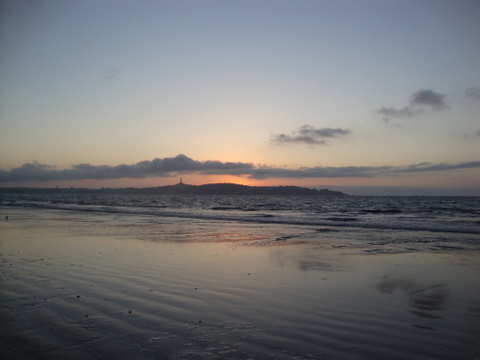
    Our plan was to visit a giant cross.   Every night in La Serena, we go down to the beach and watch the sun set behind a giant cross up on a hill.  Every night we say, “We really should go over and check out that cross.”

    Our guidebook explains that it is the  Cruz del Tercer Milenio in the nearby town of Coquimbo. Our guidebook also says it’s open until 10:00pm every night.

    Let's go check it out.

    So, last night we drove over to check out the cross.  Coquimbo is a port town  built into the hills.  It was only a few minutes away by car, but it had a completely different feel than La Serena.

    After driving through town, out of town, and up a hill, then walking several blocks we found the cross to be closed.

    Cross closes at 6:30

    So, we did the next best thing, or maybe something even better. We walked around town. Maybe it was the time of day, or just the town, but there was such a peaceful feel to the streets. Kids talked to us, dogs stared at us, and adults smiled when we walked by.

    I love taking photos of houses and doors. It was almost like the dogs were purposely posing for me.  A few cats and kids were also ready for a closeup.

    The cats were cute too.

    This little girls was especially adorable as well.

    If we had planned to take dog photos in Coquimbo I’m sure either they wouldn’t have been out, or they would have run away or something. Sometimes you can’t plan it, you just have to let it happen.

    We also ran into this group of kids who asked us our names.  Jeff they could handle but Sheryl was not only impossible for them to say, it was hysterically funny to them.

  • Pisco tasting- who knew pisco was so good, or what it even was.

    The big drink in Chile is pisco sours. They are offered everywhere and not just for tourists.  Everyone seems to be drinking them.   The first one we had was a freebie in a hotel in
    Antofagasta.  We drank it down, thought it was good, then ordered a glass of wine.

    But, a few nights ago we tried them again, and were amazed. They tasted similar to a margarita without the salt or nacho chips.

    I wasn’t even sure which part was the pisco, was it the alcohol or the juice?   It turns out pisco is a type of brandy made out of muscat grapes.

    And, as luck would have it, La Serena is near the Equi Valley which is a large producer of pisco.  And even luckier, you can go pisco tasting in the valley.

    I want more, let's go to the source and taste it there.

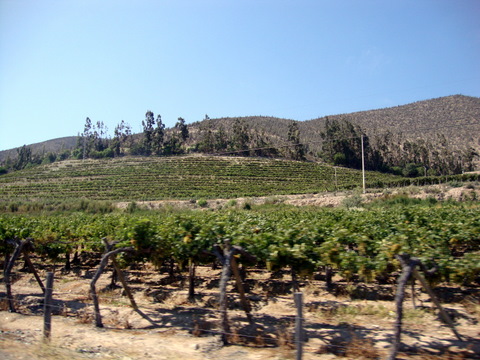
    We drove to the town of Vicuna which was worth the drive in itself.  The valley was full of pisco vineyards


    We started our pisco tasting at a distillery called Fuegos.  We pulled up and the guy parking his truck had to run and find the woman that runs the tasting room.  But, we were happy to see it  was open for tasting, more than we can say about our last tasting experience.

    This is the tasting room?

    The tastes were small, but this stuff is brandy, so a little went a long way for me.

    Next up was Capel. They are the granddaddy of pisco in this area.  Every sign in the nearby town of Vicuna had a Capel logo on it.

    Capel had a huge facility with a paid tour in  Spanish or English.  The English one was in session when we got there. Turns out it was only 5 minutes into the tour, but not wanting to miss a second of it (since we had paid the equivalent of $3 each) I insisted we go on the Spanish speaking tour.

    This meant I didn’t understand a single word for the hour long tour.  From what I gather, they take grapes, ferment the juice, put it in big tanks, then put it in some oak barrels, then distill it…or something like that.

    no clue what this is for

    This little boy on the tour understood about as much as I did . One thing I don’t think was covered in the tour, although I don’t really know, Peru also claims pisco as their national drink. There is a big controversy between the two countries over pisco.

    Then we got to the tastng room. You don’t need to understand Spanish to taste pisco. Well, actually it doesn’t hurt.

    The group was ushered into a room where we sat in a circle.  The guide prepared a tray with sample cups filled with different flavored pisco drinks.  They passed around the tray.

    I’ve been to enough wine tastings and coffee tastings to know, when presented with a tray like this, you should take one of each to compare.   No, actually not with pisco, you only take one.

    Then after the tray went around, the guide opened a bottle of a reserve pisco and started pouring samples behind a counter.  She asked if anyone would like to try this pisco.  Jeff and I ran to the counter. She handed out samples to Jeff and the other guys standing there. She looked at me and said in Spanish, “Are you sure YOU want one?”  I guess women don’t normally drink this kind of pisco.   Not knowing how to answer “Um, yeah, hand it over.”  I just said, “claro.” which means of course.

    When the tastings were over the rest of the group went into the sales room. Jeff, me and some others lingered and finished off the left-over samples on the tray, another trick I learned from coffee tastings.

    Sadly, our suitcases are too full to bring any pisco home, so I’m hoping we can find it in the USA.

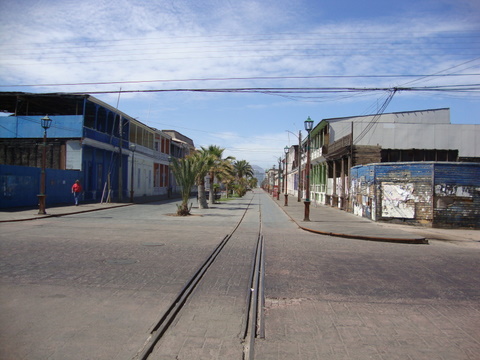
    After a quick nap in the parking lot, we went back into the town of Vicuna where I took a lot of photos

    They have weird mannequins in Vicuna too.

    The pisco tastings were great in that pisco is good, the tasting rooms were actually open, the valley was beautiful, and the town of Vicuna is a fun place to wander around in by itself.

  • Salta to La Serena – maybe rain isn’t so bad

    I hate rain.   I don’t like thunderstorms, drizzle, sprinkles, mist, or showers.   So, after 2 months in Salta during the rainy season, a Chilean  desert sounded like a good change.

    Everything started well enough.   Our landlord Bernardo drove us to the Salta airport.  Getting Jeff’s bike suitcase into the car was hard.

    That's so not going to work.

    But it fit and after some hefty luggage overage charges we flew to Iquique, Chile without problems.  When we landed we weren’t allowed off the plane until someone came through the aisles to disinfect us with a can of insecticide.

    I find it hard to believe this really did anything bug-wise

    Iquique is in the NW part of Chile. It is on the ocean, but is also on the outskirts of the Atacama desert, the driest place on earth.

    The beach was beautiful and the town was full of brightly colored houses against sand dunes.  Being an old mining town it felt like the old west.


    We stopped at the bus station and asked about leaving for the city of Antofagasta the next day.   There were many buses with quite a few seats on each one.  They weren’t sure if all our luggage would make it on the bus which caused me hours of anxiety, but Jeff assured me that with buses leaving hourly, surely one of them could take our luggage.

    That bus looks great, can't wait to take it.

    We left the bus station and got an Iquique beer.

    Jeff tired of hearing me worry about the luggage.

    The next day we got to the bus station with all our luggage and what do you know, all the buses were sold out.   Why didn’t we buy the tickets the day before when we were at the station? Good question. This is why we can’t be on the show Amazing Race.

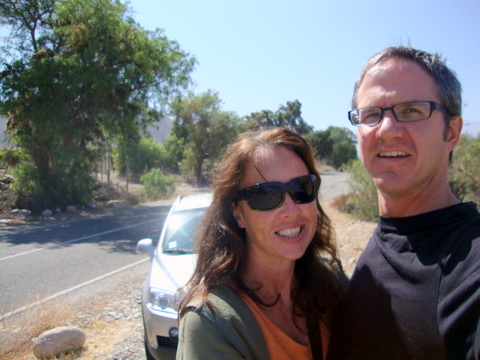
    Another day in Iquique would have been fine except we had a non-refundable hotel and flight out of Antofagasta for the next day.    I stayed with the luggage while Jeff went on a reality TV type “challenge.” Find us a way out of town.  Two hours later he returned with Chilean cell phones for both of us and a rental car. Maybe he could be on Amazing Race.

    Plan B

    The drive from Iquique to Antofagasta was amazing.  For seven hours we had the coast on one side and dry desert on the other. Besides a few small mining towns along the way there was no signs of life. No trees, grass, tumble weed, birds, nothing.  This desert never gets rain, N-E-V-E-R. Entire years go by with no rain. After 17 years in Seattle and 2 months in Salta during the rainy season, this seemed like a great place to live.

    The first two hours were breath taking. Driving this close to the water for hours reminded me of Caramel, CA.  I was ready to move here.

    Hours three and four were still beautiful but, I realized that perhaps no plants and animals lived here because there was no rain. And land without plants or animals is kind of stark.

    We stopped for lunch in a tiny little mining town where this stray puppy sat by our table. He would have been cute no matter what, but after 4 hours driving in the desert without any sign of live he was especially adorable.

    Desert puppies are especially cute.
    Wait is that a bird? No, just a piece of paper.

    After six hours of driving I half expected a spaceship to land next to the car.  So much land without plants and animals started to feel like the surface of Mars.

    could you ever get sick of this view? Yes, after 6 hours you can.

    It started to feel like a highway treadmill, no matter how long we drove there was just blue ocean on one side, and dry, brown sand on the other.  Once in awhile we’d see a small town flash by in the rear-view mirror.

    It’s amazing to see these small towns and some really really poor people living with an amazing view, but hard hard landscape.

    Then at almost the end of the drive we came across this cemetery.

    Is that a cemetery on the right?

    We drove right by it at first and had to do a double take. It was shocking to see this cemetery with all wooden grave markers in the middle of nowhere.


    It was a far cry from the elaborate cemeteries we had seen in Buenos Aires.  It was eerie to see these wooden, weather beaten graves in the middle of such  lifeless desert.

    Then, after 7 hours, we made it to Antofagasta,  We made the flight the next day and landed in La Serena. We both were relieved to see some grass near the runway.

  • Coca leaves – an altitude wimp’s best friend

    There’s no way around it. I’m a wimp.   I get winded going up stairs, have to eat every two hours, need lots of water and sleep, don’t like cold, hot,  humidity, wind, snow, rain, and worms.

    So, it’s no surprise that I’m sensitive to high altitudes.     When we stopped in the town of Humahuaca at 9,100 feet above sea level Jeff and Dean felt fine,  I felt weird.

    Walking around town I was headachey, dizzy, and tired.   It must have been obvious, because as I staggered by a row of stalls, every woman held up a green bag of coca leaves.

    coca leaf sellers

    I bought a bag for the equivalent of 75 cents, took out some leaves and started chewing.  They taste exactly like you would think dried leaves would taste like, bitter, hard and kind of gross.

    But they really did help. By the time I walked up a giant set of stairs to meet Jeff and Dean  I felt like myself again.  The only effect besides not feeling altitude sick  was my lips and tongue went numb.

    That night in Ticara at 8,200  I started feeling sick again, so pulled out more leaves at dinner.  After chewing several mouthfuls I felt much better.

    Then the next day when we hit the pass on the way to the Salinas Grandes and got up to 14,000 feet I felt positively awful.  But, after chewing a wad of leaves I felt better

    Coca leaves are chewed and legal in Boliva, Peru, Ecuador and parts of Chile and Argentina, but not legal everywhere. They are illegal in the US in the “out of the bag” form.

    They’re illegal because they are one of the ingredients in cocaine. But in the amount I was chewing they had no drug effect.    You would need tons and tons of leaves, and other chemicals to have any cocaine effects.

    Surprisingly, they are also an ingredient in Coca Cola.   They are specially imported into the US and “de-cocained.”   You can also buy them on Amazon.com  Not sure if they are “decocanied” or not.

    All I know is that as I was legally chewing them, I had no drug-like effects, but did feel much much better at 14,000 feet.

    http://www.youtube.com/watch?v=mYRmPiUknvg