Category: videos

  • Putting the salt into our stay in Salta

    We just got back from a road trip to see this giant salt flat.  You might think, “Well of course you’re living in the city of Salta.” But, this giant field of salt is not in the city of Salta, or even the province of Salta. It’s in a province called Jujuy.   I’m not sure what Salta is named after, but I don’t think it’s this.

    It’s always surreal the first time you see someone from home in a foreign country.   Our Seattle friend Dean is in town and when I met up with Jeff and Dean after my Spanish class, they were in the main square eating empanadas and drinking malbac as if it was the most normal thing in the world to meet for dinner in Salta Argentina.

    When Dean suggested a road trip through the mountains north of Salta, we jumped at the chance to join him.

    We started in Salta, drove up to Purmamarca, continued on to Humahuaca, circled back, slept in Tilcara, then drove to the Salinas Grandes the following day.

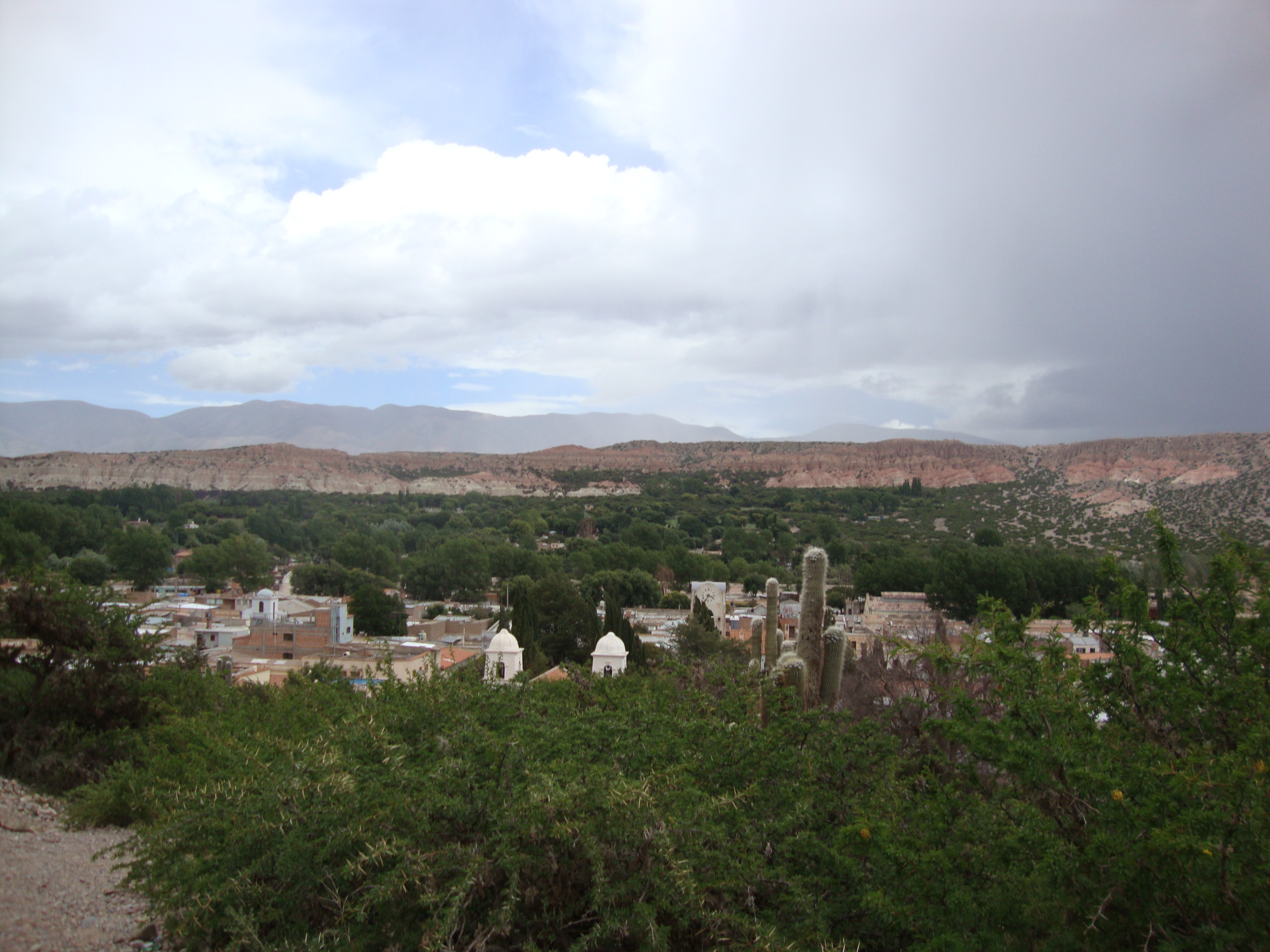
    To say the mountains and canyon were breathtaking  sounds cliche, but I really don’t know how else to describe it.    We went through lush green valleys, dry cactus studded canyons, a torrential downpour, dry bare mountains and ended in a blinding white field of salt. And, in between we stopped in some incredible small mountain towns.


    The town of Purmamarca was the most striking with multi colored mountains behind adobe  buildings on dusty streets.


    In Humahuaca the city was truly nestled in the mountains with lots of craft stalls and indigenous women and children selling blankets.

    We spent the night in Tilcara, a town we’ve been to before.   It was fun to be able to walk the streets at night, hear some late night music, and walk around as the town came to life in the morning.

    I was thrilled to come upon these hamburger patties in a store in Tilcara.

    Who wants a barfy?

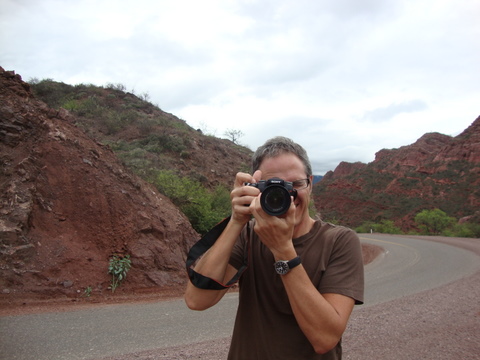
    The next day we drove through part of the Andes.  They weren’t the snow covered peaks you think of when you think Andes, but we did get up to 14,000 feet.  I do not have that many photos from this part of the trip because most of it was spent in the backseat with my hands over my eyes. Dean drove these the mountains really well, but I don’t do that well with heights.

    Can you tell I'm on a the verge of a panic attack?

    Once we were through this mountain pass we came to the salt plains.  It was unlike anything I’ve seen before, just a giant field of salt for as far as you could see.   It looked like you were walking on a giant cloud or snow field. But, it was hot and the salt crunched underfoot. We of course had to try it and…it tasted like salt.


  • Cafayate wine tasting score: Zeunerts 1-siesta 5- bus 1

    I’d love to say that we just came upon this llama out grazing or perhaps carrying a load of goods for a it’s owner.  But, in reality this was a photo op with a tourist llama. We paid fifty cents to get our photo taken with him.

    We hadn’t planned a day of tourist llamas, the day was supposed to be spent wine tasting.   Cafayate is the center of high altitude Argentinian wine production.  We’ve been drinking some excellent wine from the region and wanted to taste it at the actual wineries.

    There are several ways to wine taste in Cafayate. You can rent a car, go by bus, stay several nights, or go on a one day tourist excursion.  We opted for the excursion.  The tour was to stop at several sites along the way, the we’d have from 12:00 to 3:00 in the town of Cafayate.  There are about five wineries in town.   Jeff and I are experienced high speed wine tasters.  Smell, swirl, sip, run like hell to the next winery has always been our method of tasting wine.  We were confident that we could hit five wineries in three hours no problem.

    The ride to Cafayate was stunning. We went through a gorge and canyon stopping along the way for photos.   The multi colored rocks, and formations like Devil’s Throat alone were worth the trip.

    Devil's throat

    The bus got to Cafayate around noon and stopped at winery number 1, Nanni.   We had a great tasting there.

    The other two couples on the tour weren’t interested in tasting wine. You can see them in the background in the photo.   We left them to have lunch while we quickly scarfed down some empanadas and coffee.  We couldn’t wait to taste more wine.  We walked quickly to winery number two.

    Winery #2 – closed for sietsta

    Wintery #3 – closed for siesta

    Winery #4 – closed for siesta

    Winery #5 – closed maybe forever

    You would think after almost three months in Argentina, we’d realize that businesses close from 1:00 to 4:00. Honestly, it never crossed our minds before doing this tour.  Finally we accepted the fact that we weren’t going to get into any wineries.

    We raced to a wine bar.   We asked to see a wine menu. They didn’t know what we meant. We asked if we could do a tasting.  The waiter didn’t understand. Maybe several half glasses?  Still didn’t get it. How about just a glass of wine? No, they didn’t offer glasses of wine, only bottles.

    not exactly Purple or Poco (2 Seattle wine bars)

    We wandered around town, circled back and retried several wineries. Finally with only fifteen minutes before the bus left, we ran to a restaurant and ordered any two random glasses of wine. We chugged them and got back on the bus.

    On the way back to Salta we stopped at a winery…just to take photos. We weren’t actually allowed into the winery.  We did stop and see more really beautiful scenery.

    But the tourist llama really was really the best part of the trip.


  • Eating an entire cow (not in one sitting) part 9 – Rib cap and queperi?

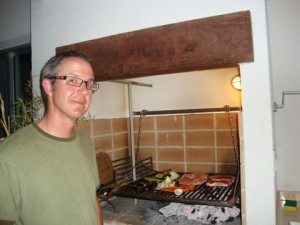
    One of the great things about our Salta apartment is that it comes with a parilla (Argentinian barbecue grill).   And, one of the great things about Jeff is he’s willing to be an asador (barbecuer).

    The Argentinian grill looks sort of like a built in shelf under a chimney.   The giant rack comes with a crank, so you can adjust the height of the grill over the burning wood.

    We’ve tried it several times.  For the first one, I started slicing veggies and salting the meat around 8:00pm.    It took slightly longer to light and cook the meat than intended. We sat down to dinner at 1:00am.

    But, since that first attempt, Jeff has gotten quite adept with the grill.    Several things are different about our asadors (the name for the actual barbecue as well)  versus the traditional ones.    1. Number of people attending – traditional asadors have lots of people. Since we don’t know many people here, the largest one we had was attended by three people, Jeff, me and our friend Stephanie.

    our first dinner guest

    2. Order and kinds of meats – traditionally there is a specific order which starts with organs, then sausage, then meat.   The order in our asadors is  sausage, meat, chicken, veggies, usually more veggies than sausage, no organs at all.

    3. The cook knows what he’s cooking.    Our method of obtaining the meat  is to go to our local butcher.   We always prepare ahead of time with a list of nicely translated words for cuts of beef.  But, we either loose the piece of paper, or get confused when the butcher starts talking fast.
    I then say “parilla” several times and point to the case of meat.     The very nice and patient butcher cuts me several different cuts of meats.    We bring them home and look them up on google.   This last time we came home with what turns out to be  flank steak,  rib cap and something that was delicious, but no idea what cut of beef it was.   So, until I can find a definition for queperi or learn to pronounce it in a way that people can actually understand me,  the queperi portion of the cow will go uncolored.

    what is queperi?

  • Tilcara – Taking a break from cow…to eat llama

    Normally, we would never go anywhere that was over 3 hours away on a day trip.  That would be like going from Seattle to Salem, OR or Chicago to Cedar Rapids, IA and back in a day. But, Argentina is large and it takes  longer to get everywhere on a bus.

    We made sure to get on the correct bus this time. I asked every single driver at the station, multiple times.  Poor Jeff was had to pretend he didn’t know me.

    We were the only ones doing a day trip, everyone else were college aged Argentinian backpackers. We could tell because besides backpacks, they all had mate gourdes, thermos, and guitars.

    They showed the movie Happy Madison dubbed in Spanish.  You don’t really need to know Spanish or be 21 to enjoy the movie, but it helps.

    some of us enjoyed the movie more than others

    Once we got to the town it worth a 4 hour bus ride and Adam Sandler.

    Tilcara is an amazing little town nestled in the mountains in the middle of the desert.  The backpackers and tourists seemed to outnumber the locals by about 10 to 1, but it didn’t matter.  Even in this tiny town we had entire streets almost to ourselves.

    For lunch we went to a restaurant that served “regional specialties.”     After having so much beef it was a nice change to see llama (pronounced jama) on the menu.

    We had the choice of several  llama dishes, we went with the llama casserole.

    Just having some veggies and not just a hunk of meat on a plate was nice.  The llama was tender and flavorful, tasted nothing like chicken.

    I think llama might have once been a local dish, but no one other than tourists and gourmet foodies are eating it now. It’s probably similar to rabbit. You can get rabbit in fancy restaurants in the US, but very very few people in the US are sitting down to rabbit sloppy joes or rabbit tacos at home.  Traditional or not, it was super good food on a super long but fun day trip.

  • Eating an entire cow (not in one sitting) part 8 – T Bone and Short Ribs

    There really isn’t much to report on the eating of a T Bone steak called – beef de costilla and short ribs called tira de asado. Both were delicious.

    The thing I found most interesting the atmosphere in the parilla.  We went to a restaurant called El Viejo Jack. Not only is it highly recommended in guide books and on Trip Advisor, it’s also recommended by locals.

    The restaurant itself was your basic local parilla with the most glaring fluoresent lights ever.   We’ve noticed this is pretty typical of local parillas.

    could it have been any brighter?

    It was funny to eat a delicious steak, drink a bottle of really good malbac, and have great attentive service all while feeling like we were in a doctor’s examining room.

    It was in sharp contrast to a restaurant we had gone to the night before.

    Jose Balcarse was also highly recommended by guidebooks.  It was also really good, but I don’t think there were any locals in the restaurant. Even the waitress, who spoke fluent English was from Uruguay.

    this photo is directly off their website

    One thing it did really well, besides the food was the ambiance.  The low lighting and exposed brick walls reminded me of restaurants back home.   The food at both places were amazing. One seemed really authentic, local and inexpensive.  The other – gourmet  and  touristy, but you didn’t feel like you were at the DMV.

    You can really see the contrast in the below videos.

    Video at parilla.

    video at gourmet tourist restaurant.