Tag: wine

  • 7 things to love about Mendoza (besides wine)

    We love wine – buying it, tasting it, seeing where it’s made, and most of all drinking large glasses of it.

    That is why we came to Mendoza, because it’s the heart of wine country in Argentina.  But, we’re planning on staying awhile because it’s just so nice here.     Tranquil, pleasant, livable – all words used by guidebooks to describe the city. So far, they have all been correct. The wineries and vineyards are out of town, so the only wine we’ve tasted so far has been at wine bars and restaurants.  It’s been really good. But here are other things I love about the city.

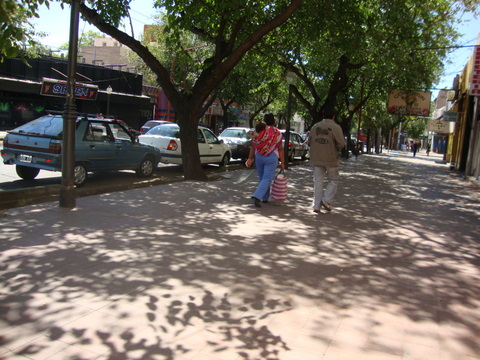
    1. wide sidewalks –the sidewalks in Mendoza are wide, wide enough for everyone to be able to walk around, even in a crowd.  No more playing chicken with oncoming pedestrians.  I no longer get stuck behind a slow poke and have to veer out into a busy street to get around them.  No one has stepped on my foot, accidently punched me in the side, or almost blinded me with a cigarette.  You can either stroll or stride and not get in anyone’s way.


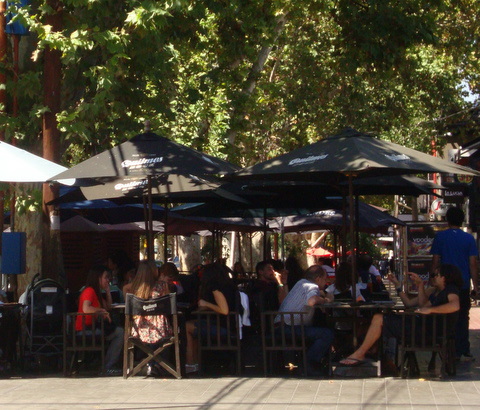
    2. couches on sidewalks – the only thing I like better than sitting outside at a table drinking wine, is sitting on a comfortable couch outside drinking wine. I hope this is a trend that is sweeping the world.

    3. trees –  the architecture of Mendoza is pretty tame compared to Salta or Buenos Aires. But, you can’t see any building because there are so many trees lining each street.  I love how every street feels like a park and the park feels like a forest.

    4. stop lights – I’m still afraid to cross the street, but having stop lights help. There are still left and right turners, but the traffic so so mellow compared to other places in Argentina.

    5. weather – I am a baby about weather. It was too humid in Buenos Aires, too rainy in Salta, too hot in Cordoba, too windy in La Serena. But, the weather here really is just perfect.


    6. restaurants – there a lot of restaurants here, fancy, casual, traditional, and trendy.    We could eat out every night for the rest of our trip and not hit all the places we want to try. And, with the exchange rate to the US dollar, they are all a bargain.

    7. taxis – taxis are cheap and plentiful in Mendoza.   We are currently staying a bit out of the center of town, but for about $2 US you can get almost anywhere in town.   The buses are even cheaper, but we haven’t figured out where to buy a bus pass yet.

    These are just what we’ve noticed about the city. Tomorrow we head out into the country to see about the wine.

  • Pisco tasting- who knew pisco was so good, or what it even was.

    The big drink in Chile is pisco sours. They are offered everywhere and not just for tourists.  Everyone seems to be drinking them.   The first one we had was a freebie in a hotel in
    Antofagasta.  We drank it down, thought it was good, then ordered a glass of wine.

    But, a few nights ago we tried them again, and were amazed. They tasted similar to a margarita without the salt or nacho chips.

    I wasn’t even sure which part was the pisco, was it the alcohol or the juice?   It turns out pisco is a type of brandy made out of muscat grapes.

    And, as luck would have it, La Serena is near the Equi Valley which is a large producer of pisco.  And even luckier, you can go pisco tasting in the valley.

    I want more, let's go to the source and taste it there.

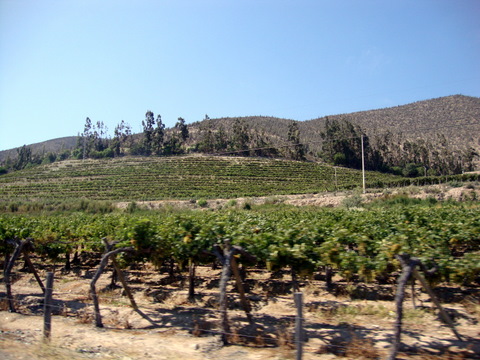
    We drove to the town of Vicuna which was worth the drive in itself.  The valley was full of pisco vineyards


    We started our pisco tasting at a distillery called Fuegos.  We pulled up and the guy parking his truck had to run and find the woman that runs the tasting room.  But, we were happy to see it  was open for tasting, more than we can say about our last tasting experience.

    This is the tasting room?

    The tastes were small, but this stuff is brandy, so a little went a long way for me.

    Next up was Capel. They are the granddaddy of pisco in this area.  Every sign in the nearby town of Vicuna had a Capel logo on it.

    Capel had a huge facility with a paid tour in  Spanish or English.  The English one was in session when we got there. Turns out it was only 5 minutes into the tour, but not wanting to miss a second of it (since we had paid the equivalent of $3 each) I insisted we go on the Spanish speaking tour.

    This meant I didn’t understand a single word for the hour long tour.  From what I gather, they take grapes, ferment the juice, put it in big tanks, then put it in some oak barrels, then distill it…or something like that.

    no clue what this is for

    This little boy on the tour understood about as much as I did . One thing I don’t think was covered in the tour, although I don’t really know, Peru also claims pisco as their national drink. There is a big controversy between the two countries over pisco.

    Then we got to the tastng room. You don’t need to understand Spanish to taste pisco. Well, actually it doesn’t hurt.

    The group was ushered into a room where we sat in a circle.  The guide prepared a tray with sample cups filled with different flavored pisco drinks.  They passed around the tray.

    I’ve been to enough wine tastings and coffee tastings to know, when presented with a tray like this, you should take one of each to compare.   No, actually not with pisco, you only take one.

    Then after the tray went around, the guide opened a bottle of a reserve pisco and started pouring samples behind a counter.  She asked if anyone would like to try this pisco.  Jeff and I ran to the counter. She handed out samples to Jeff and the other guys standing there. She looked at me and said in Spanish, “Are you sure YOU want one?”  I guess women don’t normally drink this kind of pisco.   Not knowing how to answer “Um, yeah, hand it over.”  I just said, “claro.” which means of course.

    When the tastings were over the rest of the group went into the sales room. Jeff, me and some others lingered and finished off the left-over samples on the tray, another trick I learned from coffee tastings.

    Sadly, our suitcases are too full to bring any pisco home, so I’m hoping we can find it in the USA.

    After a quick nap in the parking lot, we went back into the town of Vicuna where I took a lot of photos

    They have weird mannequins in Vicuna too.

    The pisco tastings were great in that pisco is good, the tasting rooms were actually open, the valley was beautiful, and the town of Vicuna is a fun place to wander around in by itself.

  • Chile – Peanut butter, stop signs and cheek kisses

    After three months in Argentina and less than two weeks in Chile I’m not exactly an expert on either country.  But, I’m going to pretend I am and tell you all the differences I’ve seen so far.

    Wine – the wine is good and cheap in both places.  Argentina was all about malbec.   Chile is all about cabernet sauvignon.  Luckily, we like both…a lot.

    Cheek kiss – In Argentina they cheek kissed all the time, everyone men and women.   Jeff was never completely comfortable cheek kissing other  men, but after three months he got used to it.  He did it enough that it became automatic.

    On our second night in Chile we ran into our taxi driver from the day before in a gas station.   He kissed me hello, chatted and he cheek kissed me goodbye.    Then a week later we were signing our lease in La Serena.  As he was leaving Claudio, our rental agent cheek kissed me.  He shook Jeff’s hand and Jeff automatically cheek kissed him.   It was totally normal, our Argentinian landlord was constantly cheek kissing Jeff.

    Claudio pulled back, laughed and quickly explained to Jeff that in Chile men only cheek kiss women, not other men.   Jeff was embarrassed, Claudio amused and I almost died laughing.

    Stop signs and lights – Chile has them, Argentina doesn’t.    After three months I still never knew how to cross the streets in the big city of Buenos Aires to the smallest little town, I just sort of waited for traffic to clear, said a little prayer and ran across.  In Chile there are actual stop signs and lights, and even walk signs.

    Butter – Both countries eat a lot of bread. In Argentina they do not eat it with butter, at least not in restaurants.  They serve it with different kinds of saucy spreads which are good. But, if I’m going to ruin my diet with a bunch of carbs, I like to include fat grams as well.

    Yum, butter, and also that other stuff.

    Money – you need it in both countries. In Chile you need more of it. Chile is much more expensive than Argentina, at least as a tourist.   But even more crazy is the exchange rate.  Argentinian pescos are 4 to one US dollar.   That got a little confusing, but even I was able to figure that out without a calculator.  Chilean pesos are  480 to one US dollar.  That is something I can’t do in my head. I can barely do it on a calculator.

    10,000 pesos? I'm rich…oh wait, no I'm not, that's only $20 US dollars.

    Peanut butter and granola bars – You can get a surprising amount of US type things  in Argentina and Chile – oatmeal, cereal, granola, potato chips, etc.  But some things you just couldn’t get in Argentina. Peanut butter was one.  US style granola bars were another.   This brand has an entire display in the grocery store with all kinds of US type products.

    Empanadas – They have them in both countries, but  they are very large in Chile.  The first time we had them in Chile we ordered 5, the normal amount we used to order in Salta.   The waitress must have been laughing her ass off when she prepared them. Five empanadas is enough for a family of 4. They are huge.

    Meat and seafood – This is obvious, but the meat in Argentina is amazing. The sea food and fish in Chile is amazing.

    They still have weird looking mannequins like in Argentina.

    This I think was a one off.  I haven’t seen this anywhere else in Chile or Argentina.

    fanciest public toilet ever
  • Cafayate wine tasting score: Zeunerts 1-siesta 5- bus 1

    I’d love to say that we just came upon this llama out grazing or perhaps carrying a load of goods for a it’s owner.  But, in reality this was a photo op with a tourist llama. We paid fifty cents to get our photo taken with him.

    We hadn’t planned a day of tourist llamas, the day was supposed to be spent wine tasting.   Cafayate is the center of high altitude Argentinian wine production.  We’ve been drinking some excellent wine from the region and wanted to taste it at the actual wineries.

    There are several ways to wine taste in Cafayate. You can rent a car, go by bus, stay several nights, or go on a one day tourist excursion.  We opted for the excursion.  The tour was to stop at several sites along the way, the we’d have from 12:00 to 3:00 in the town of Cafayate.  There are about five wineries in town.   Jeff and I are experienced high speed wine tasters.  Smell, swirl, sip, run like hell to the next winery has always been our method of tasting wine.  We were confident that we could hit five wineries in three hours no problem.

    The ride to Cafayate was stunning. We went through a gorge and canyon stopping along the way for photos.   The multi colored rocks, and formations like Devil’s Throat alone were worth the trip.

    Devil's throat

    The bus got to Cafayate around noon and stopped at winery number 1, Nanni.   We had a great tasting there.

    The other two couples on the tour weren’t interested in tasting wine. You can see them in the background in the photo.   We left them to have lunch while we quickly scarfed down some empanadas and coffee.  We couldn’t wait to taste more wine.  We walked quickly to winery number two.

    Winery #2 – closed for sietsta

    Wintery #3 – closed for siesta

    Winery #4 – closed for siesta

    Winery #5 – closed maybe forever

    You would think after almost three months in Argentina, we’d realize that businesses close from 1:00 to 4:00. Honestly, it never crossed our minds before doing this tour.  Finally we accepted the fact that we weren’t going to get into any wineries.

    We raced to a wine bar.   We asked to see a wine menu. They didn’t know what we meant. We asked if we could do a tasting.  The waiter didn’t understand. Maybe several half glasses?  Still didn’t get it. How about just a glass of wine? No, they didn’t offer glasses of wine, only bottles.

    not exactly Purple or Poco (2 Seattle wine bars)

    We wandered around town, circled back and retried several wineries. Finally with only fifteen minutes before the bus left, we ran to a restaurant and ordered any two random glasses of wine. We chugged them and got back on the bus.

    On the way back to Salta we stopped at a winery…just to take photos. We weren’t actually allowed into the winery.  We did stop and see more really beautiful scenery.

    But the tourist llama really was really the best part of the trip.


  • Staying in Salta

    I’m relieved and happy to report that we really love the city of Salta and plan to stay for awhile. After dragging all our suitcases onto the wrong bus to Salta, I really don’t want to go anywhere else for awhile.

    Here is my top ten list of what I love about Salta:

    1. Beautiful City – there are colonial buildings, parks with palm trees and mountains in the distance.

    2. Amazing apartment – I’m sure hardcore travelers/expats can live anywhere, but we’re not hardcore.  We need a nice place with the internet, a couch, and big bed.   We got so lucky with the apartment we’re renting. It has all those things and an amazing deck with a jacuzzi.

    view from our apartment

    3. Nice people – the people here are super friendly and patient with my lack of Spanish.   The cheek kiss is popular. I find myself cheek kissing 2-3 people a day. (not including Jeff).

    4. Small city feel. There are 500,000 people here, but horse drawn carts still go down our street. This one unfortunately had a megaphone.

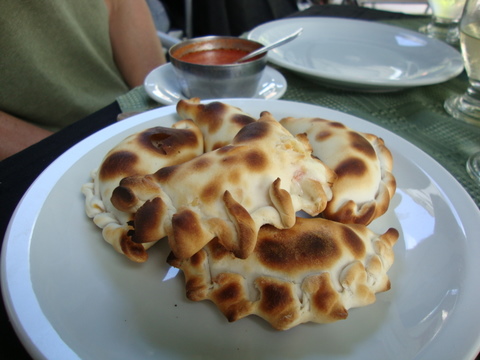
    5. Empanadas (and other delicious foods)

    Humita – tamale-like corn dish

    6. Good cycling for Jeff -Jeff’s found a great group of guys to ride with.

    7. Yerba Mate – we see the gourds everywhere and bags of it sold at the grocery stores. I bought some in tea bags to start.  Tastes good but leaves a nasty green ring in the cup.

    8. Interesting cultural stuff – honestly, we haven’t done anything cultural yet.  But here’s a guy just hanging out in a full gaucho outfit talking to someone on a bike.  I’m sure he’s dressed up for a tourist activity, but you have to love the pants.

    9. Wine – The town of Salta is in the province of Salta which is known for high altitude wine.  So far all the wine we’ve tried from this area has been good.  We’re hoping to do some trips out to the vineyards soon.

    10. Three alfajores for a peso –  How can you not love a town where the bakery down the street sells 3 alfajores (two shortbread cookies with dulce de leche in between) for a peso, the equivalent of a quarter.  And, the nice older couple that own the store talk to me in Spanish every time I go in.

    What I don’t like about Salta:

    1. Rain – turns out January and February are the rainy season.  Seems like we left Seattle’s rainy winter to go to Salta’s rainy summer.  Ironic isn’t it?

    2. Lack of Veggie Variety – this idea of eating what’s local is great until you actually are in a place where you can only get local vegetables.  I dream of  a produce aisle filled with vegetables shipped in from all over the world, carbon footprint be damned.

    3. Lack of good coffee – there are lots of places to go out and get good coffee, very hard to buy good beans in the grocery stores.  Instant and robusto beans yes, Arabica not so much.

    Luckily, the dislike list is short, and who knows, dislike #3 might just get us to switch to yerba mate full time.